Skip to the content
 Commercial & Industrial Application Note
Case Study
Voltage stability
Utility noncompliance
PQube 3, advanced system modeling, real-time simulations
Industrial environments with rapidly changing loads often rely on static synchronous compensators (STATCOMs) in power systems to stabilize voltage with both inductive and capacitive reactive power (VARs). However, an industrial customer recently contacted Powerside upon experiencing an operating environment that was far more complex.
The customer’s system included a regenerative load driven by an active front-end (AFE) source inverter. Unlike typical loads, this system both consumed and returned power, creating rapid and continuous voltage swings that would rise during regeneration and drop during load draw. At the same time, the system was grappling with a weak electrical network with low X/R ratio (X = reactance, R = resistance), meaning it was extremely sensitive to both real and reactive power.
With a strict voltage excursion compliance criteria, the customer found themselves in a high-stakes scenario where non-compliance would result in a loss of interconnection permitting.
The customer’s load was on a weak system that resulted in significant systemic voltage impacts, leading to a much stricter voltage excursion criteria:
Compliance was required at two separate locations:
Maintaining voltage within such tight tolerances across two points—each with different X/R ratios—made for a significantly complex challenge. Additionally, the utility had other customers connected to the same substation, requiring careful coordination to avoid unintended impacts upstream.
The client’s initial solution to their bi-directional voltage excursions was to provide real power compensation at each of their sites—but at a whopping $4 million per site, they needed expert help for precise voltage control, without the large-scale cost.
Powerside was brought in to help.
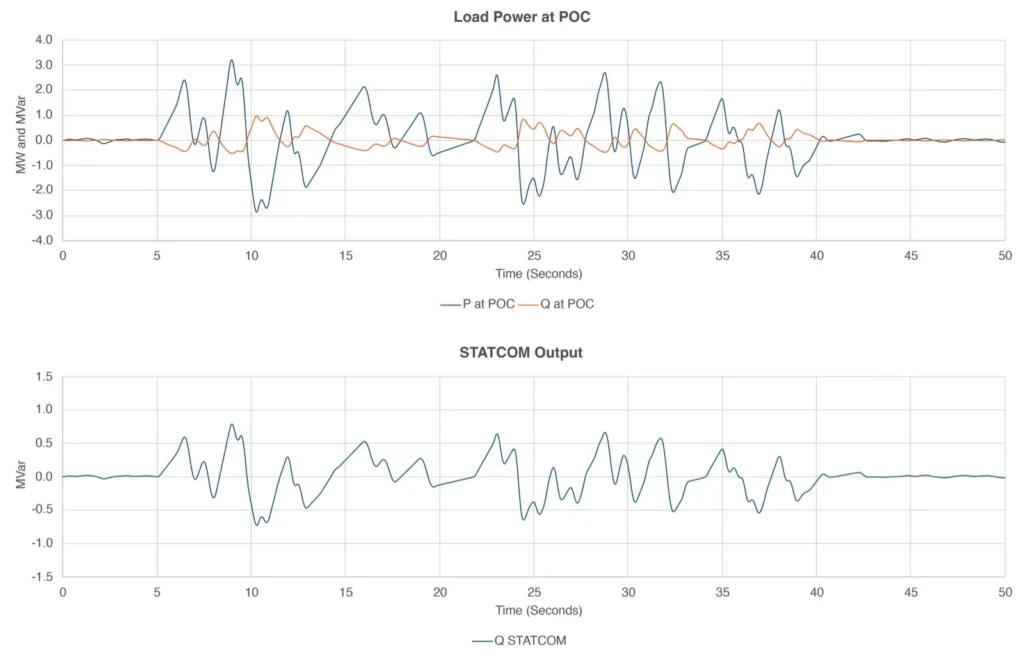
Powerside approached the problem through advanced system modeling and real-time simulations, testing how different compensation strategies would perform under real-world conditions. By adjusting the STATCOM and real power input variables, Powerside identified an optimized solution.
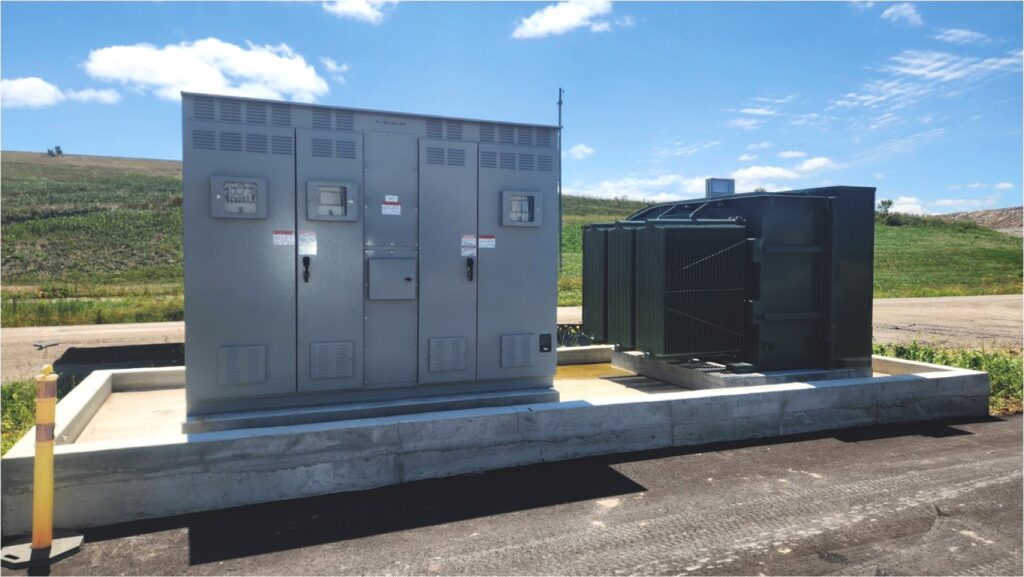
We deployed a 0.78 MVar-sized STATCOM to provide targeted reactive power compensation, successfully meeting the power requirements at both the PCC and connected substation. By using an advanced PQube® 3 power quality analyzer at both the PCC and substation, our engineers could observe system behavior in real time and fine-tune the STATCOM’s response to ensure strict utility requirements were met.
When electrical issues challenge you beyond standard solutions, Powerside brings innovative power quality expertise to deliver precise results.
Reach out to us today to learn more about how Powerside can help you solve your most complex power challenges.