 Skip to the content
Mines and quarries rely on medium voltage (MV) variable frequency drives (VFDs) to keep critical equipment operational. Many of these sites feed associated plants where further refinement occurs — but transporting the raw material to the plants from the mines poses a challenge. The two most common ways used are trucks and conveyer systems, and conveyors tend to be the most economical option.
When conveyors are used, there are often multiple electric motors powered by MV VFDs running in coordination. The length of the conveyor determines how many motors and drives are required, and conveyors can extend for miles.
Coordinated drive systems like this can be tricky to set up and troubleshoot. Typically, one VFD serves as the “master” while the others are “followers.” A proper setup reduces the push-and-pull effect on the motors and prevents overload or overcurrent faults on the VFDs, allowing the load to be shared equally without one motor taking the brunt of the work.
Recently, EMA service engineers were involved in remotely troubleshooting a coordinated drive system on a long conveyor line at a cement plant. Troubleshooting a coordinated MV drive system is challenging enough in person, making remote support particularly difficult.
In this case, three Toshiba T300MVi Medium Voltage Drives were operating in a master/follower conveyor system and experiencing intermittent overcurrent (IOC) and overload faults. After reviewing traceback files provided by the customer, several potential causes emerged, including:
- A speed mismatch
- Oscillation/tuning issues
- Mechanical issues on the pulleys/gear box
- Elasticity of the conveyor belt itself
Unfortunately, without additional information, it was virtually impossible to determine the root cause of their issue remotely, and due to budget constraints, the customer couldn’t afford a service call.
This is where continuous drive monitoring can provide significant value.
With Powerside’s DriveScan MV Drive Monitoring Software installed on the three drives, the team could have viewed the speed of all three VFDs in real time, making it easier to see if speed mismatch was the problem. The constantly trending historical data would also have revealed if anything had changed over time, indicating a possible problem.
DriveScan could also have supported real-time adjustments to the speed loop gains to help tune out possible mechanical issues due to worn belts or pulleys. Through the DriveScan dashboard, critical VFD data can be viewed remotely, providing the visibility needed to troubleshoot and optimize without requiring an immediate site visit.
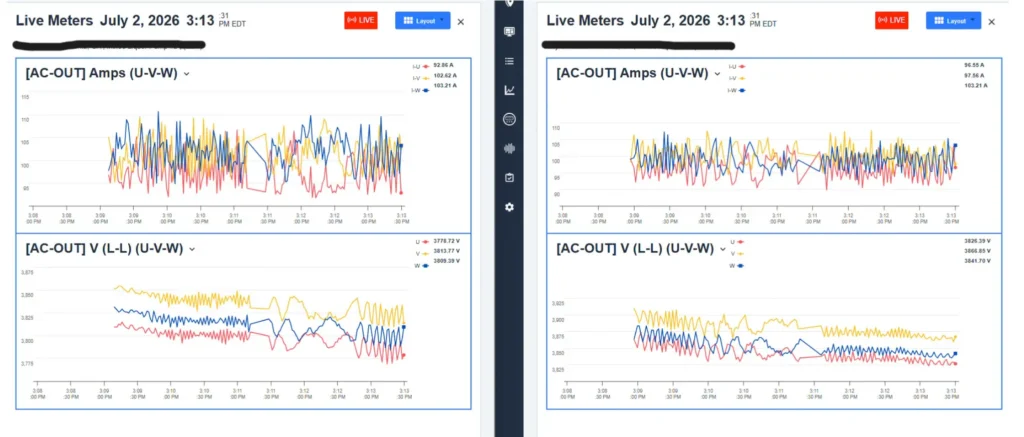
For coordinated drive systems, output voltage, output frequency and output current are all important readings to have to make sure the drives are properly synchronized to prevent oscillation.
In the screenshot below, output voltage and current from two MV VFDs at separate locations are compared at the same time. This functionality is invaluable for remote troubleshooting as well as root cause analysis and predictive failure.
Whether you have multiple MV drives operating in coordination or a critical drive that simply can’t afford to go down, Powerside’s DriveScan remote monitoring technology can provide greater visibility into performance and help teams troubleshoot more efficiently.
Learn more about DriveScan and how continuous monitoring can support your critical MV drives.