 Skip to the content

Harmonic voltages can cause problems in semiconductor fabrication plants (“fabs”) and are, in turn, caused by harmonic currents drawn by semiconductor tools. But precision is critical for these fabs and, as such, some are now demanding that tools meet the requirements of IEEE 519 — a standard that sets specific limits on harmonic currents.
In this article, we’ll explain those limits, how to determine semiconductor compliance using existing tests and provide possible solutions for when a tool does not already meet those limits.
First, What Exactly Are Harmonics?
Simply put, harmonics describe a waveform on an AC power grid. If there are no harmonics, the waveform is a pure sine wave — usually 50 or 60 Hz. If there are large harmonics, the waveform is distorted.
The two primary types of harmonics are:
- Voltage harmonics (distorted voltage waveforms), which cause semiconductor tools to mis-operate and can cause earth leakage relays to trip.
- Current harmonics (distorted current waveforms), which cause increased heat loss on the conductors and transformers in the fab’s power distribution system.
When applied to the fab’s harmonic source impedance, current harmonics create voltage harmonics.
And, as mentioned, some fabs now require that tool vendors comply with IEEE 519 in the absence of other defined standards.
The Basics of IEEE 519
IEEE 519 was first written to be applied at “the point of common coupling,” which is typically interpreted to mean “the junction between a utility and a consumer” — i.e., the revenue meter. However, conceptually, it is possible to apply it to the junction between a fab electric supply and a semiconductor tool. The key concepts of IEEE 519 include:
- Limiting voltage harmonics, so they don’t disrupt sensitive loads.
- This is done by first limiting the harmonic currents drawn by the semiconductor tools. The harmonic current limits are relative to the total current available to the tool, not the THD (total harmonic distortion) or fundamental current.
- If the voltage is still distorted after the harmonic currents have been limited, that is a problem to be fixed by the fab.
- Measurement must be according to IEC 61000-4-30. Often, this can easily be accomplished during SEMI F47 voltage sag immunity testing, especially when a SEMI E6 report is included in the testing.
In short, IEEE 519 states that the semiconductor tool is responsible for drawing limited harmonic current, but only relative to the total current that is available to it. The fab is then responsible for harmonic voltages.
Understanding IEEE 519 Limits
Because IEEE 519 has such broad applications, there are many different limits, spanning various tables. But for semiconductor-tool current, the first row of the following IEEE 519 table (“Table 2”) generally applies.
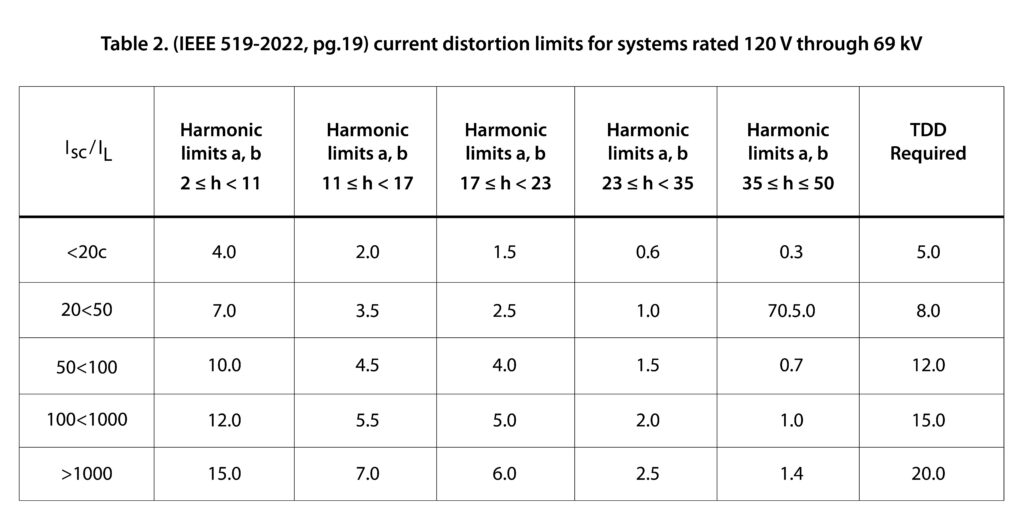
Note that these limits are all in percent of IL, not in percent of fundamental. For semiconductor tools, IL can be reasonably interpreted as the main circuit breaker rating in amperes (“amps”). For a more conservative interpretation, one could use the maximum current drawn by the tool during the worst-case operating situation.
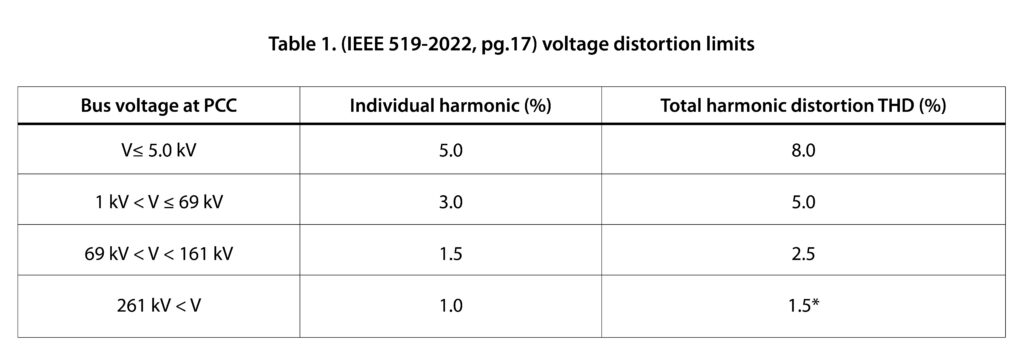
Separately, the following table (“Table 1”) sets the limits that fab electric supplies must meet when all tools comply with Table 2.
How to Measure Tool Compliance
Fortunately, any tool that has a properly prepared SEMI E6 Report has all the information necessary for determining compliance with IEEE 519.
SEMI E6, Section 12.2.21, requires measuring and reporting the tool’s harmonic currents coincident with the apparent power maximum. Simply divide each of these harmonic currents, in amps, by the tool’s main circuit breaker rating IL, also in amps. Then, express these ratios as percentages. If the percentages for each harmonic are less than the limits in Table 2, the tool complies with IEEE 519.
Again, Table 1 does not apply to tools — it is a requirement on fab electric supplies.
Not IEEE 519 Compliant? Get the Solutions You Need with Powerside.
Most semiconductor tools are already compliant with IEEE 519. However, if measurements determine that your tool is not actually compliant, there are solutions available after proper engineering analysis. These solutions could look like increasing IL through increased main circuit breaker ratings, adding series hardware and/or parallel passive or active harmonic filtration, among others.
Power Standards Labs and Powerside have extensive experience in all aspects of semiconductor fab power quality — from analysis and SEMI F47 compliance testing to the manufacturing of world-class active harmonic filtration solutions and engineering services.
Start a conversation with a Powerside specialist today to learn more about semiconductor tools and how we can help you stay compliant.