 Skip to the content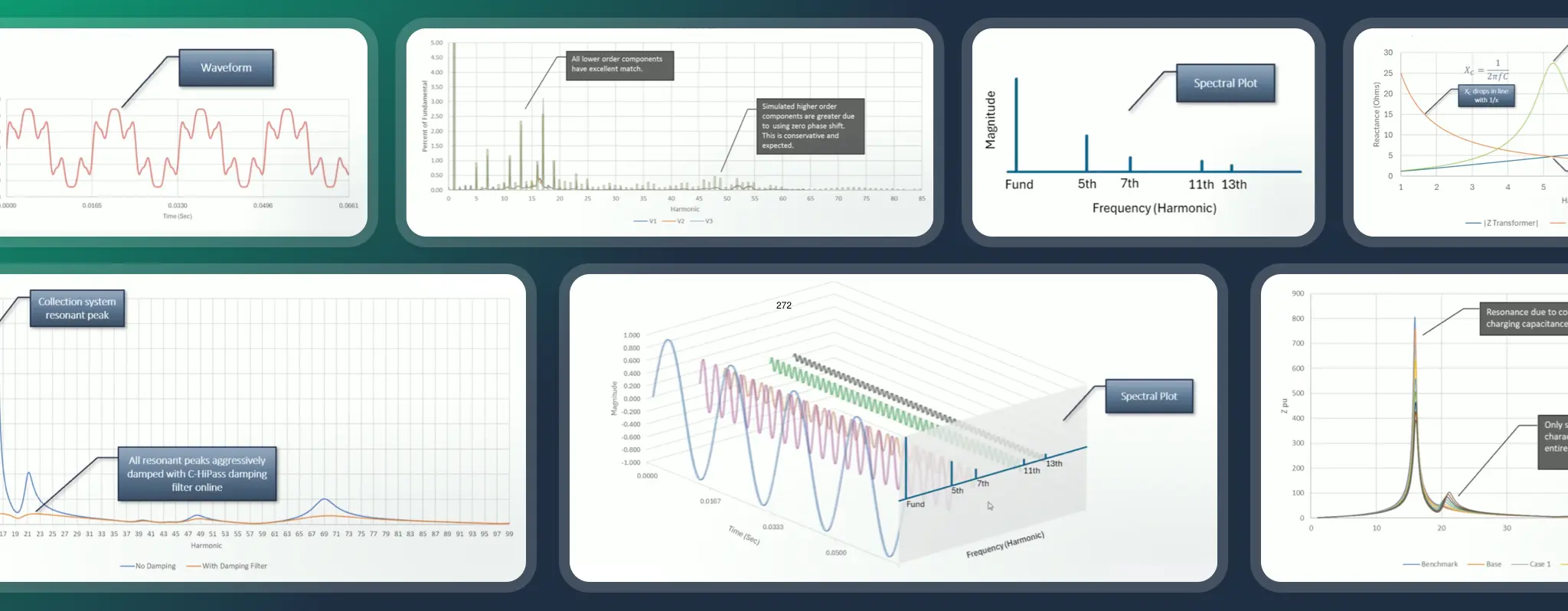
Voltage and current waveforms in electrical power systems have always had levels of distortion. However, the advent of mercury arc rectifiers in the early 1900s led to harmonics becoming a key area of study in electrical power systems. Chris Duffey, Senior Technical Fellow at Powerside, explores power system harmonic analysis in this technical video, discussing its history, relevance and relationship to power quality. Keep reading to learn the five main takeaways.
Takeaway #1: The Issue of Resonance Encouraged Harmonic Analysis
There are many issues related to harmonic distortion in electrical power systems, but one of the most significant is resonance. Harmonic resonance causes excessive and damaging amplification of harmonic voltages and currents and was a key factor in leading power engineers to study, analyze and correct power systems with harmonic issues. While damaging resonance-related harmonic issues are fairly uncommon, the fact that such damaging conditions could exist helped catalyze the harmonic analysis movement.
Takeaway #2: The Fourier Transform and Fourier Series Reveal Harmonics and Reconstruct Waveforms
As with sound and light, complex electrical AC voltage and current waves are formed from a sum of individual sine waves. A good example of this principle is seen when we use a prism to see the many colors within white light. Each color is an individual frequency that can be represented by an individual sine wave. The Fourier Transform and Fourier Series are mathematical techniques commonly used to relate complex waveforms to a sum of harmonically related sine and cosine waves for study and analysis. Through these mathematical relationships, we can break down complex waveforms into spectral components to see the harmonics at play, and conversely, we can construct a complex waveform if we know its spectral content.
Takeaway #3: Harmonic Relevance Used to Be Dependent on Your Facility
In the past, it was possible to definitively say that harmonics were not relevant to a facility if it didn’t have harmonic-producing loads. Now, however, it’s quite rare to find a plant that only uses linear loads. Over 50% of the world’s energy flows through silicon-based rectifiers like adjustable frequency drives (AFDs). Thus, having knowledge and awareness of your system’s harmonic response (via harmonic analysis) is not only relevant, but necessary in today’s electrical systems. Being diligent in this harmonic rich environment causes us to realize that harmonic analysis is now just as essential as a loading, arc flash and protection coordination analysis.
Takeaway #4: Harmonic Simulations Are Key to Harmonic Analysis
Harmonics are a steady-state condition. To perform the appropriate analysis, we typically use admittance networks and incorporate spectral sources as current injections at each individual harmonic we desire to simulate. We also typically include analysis across a frequency range from the first to the 50th harmonic. Most of the data used for harmonic analysis is the same as the data used for short circuit analysis. The key difference is that the data for harmonic analysis is augmented with details on equipment harmonic response, harmonic component models and harmonic source spectral content. Harmonic simulations help us understand distortion and a host of additional impacts (heating, over-voltage, resonance, etc.) to help engineers properly design new systems and mitigate issues in existing systems.
Takeaway #5: Harmonics — A Key Foundational Element of Power Quality
Harmonics was the movement that preceded the power quality movement in the ’80s and ‘90s. Interestingly, power quality is an industry that combines a host of well-known electrical system issues all under one umbrella, and harmonics was a key foundational element that led to power quality as we know it today. As with many other power system analyses, harmonic measurements and harmonic analysis form an effective and useful reality-simulation pair. Measurements supply data and benchmarks for simulations, and simulations help us predict the behavior of our system. This predicted behavior can then be validated by measurement and verification, completing a full-circle evaluation. (See our blog on short circuit analysis for another example of this.)
Interested in learning even more? Watch Chris’s full video below.
Engineering Services to Help Your Facility Operate Effectively
Powerside understands the importance of, and essential need for, harmonic analysis. See how our Engineering Services team can apply the discussed techniques, formulations and simulations to provide a deeper understanding of your systems’ harmonic response as it operates in today’s distorted environment.
Meet the Expert

Chris Duffey
Senior Technical Fellow, Powerside
