Most industrial facilities have a variety of motor loads being applied: across the line, adjustable frequency drive (AFD)–controlled, reduced voltage start, soft-start and more. Often, the majority of motors are run across the line, creating a need for power factor (PF) correction.
In such scenarios, the harmonics injected by AFDs do not cause significant distortion issues — meaning there is no need for harmonic filtration.
An unfiltered capacitor bank is then typically installed for reactive compensation to improve power factor. Though that is accomplished, this common application ignores an important and often missed aspect: a resonant circuit is created that can seriously amplify AFD harmonics.
To avoid the problematic amplification of AFD harmonics, best practice dictates detuning the capacitor bank.
In modern electrical networks with non-linear loads (AFDs, uninterruptible power supplies [UPSs], rectifiers, etc.), harmonics can excite resonant networks, leading to overloading, overheating and over-voltaging all networked equipment. The fact that harmonic currents are present should compel us to adopt detuning capacitor banks to avoid harmonic amplification. In fact, a recent article from Powerside, The Undamped Nature of the Modern Power Distribution System, explores this more in-depth, stating, “Resonance is a significant concern for power providers and distribution engineers.” The article specifically identifies this issue as one of the most overlooked aspects of power factor correction today.
Overcome Common Misapplication Mistakes with Powerside
At Powerside, we help our clients directly overcome the misapplication of reactive compensation by creating detuned capacitor banks tailored to their specific needs.
Detuning is accomplished by adding a reactor on the line-side of the capacitor bank so that a resonant point — which cannot be avoided with capacitor applications — is forced into a safe area with no harmonic injections. Since the lowest-order dominant harmonic present in low voltage (LV) networks is the fifth harmonic, the best way to safeguard against resonance is to detune the bank well below this metric.
Let’s take a look at two standard options.
Standard Option #1: Tune at 3.78th
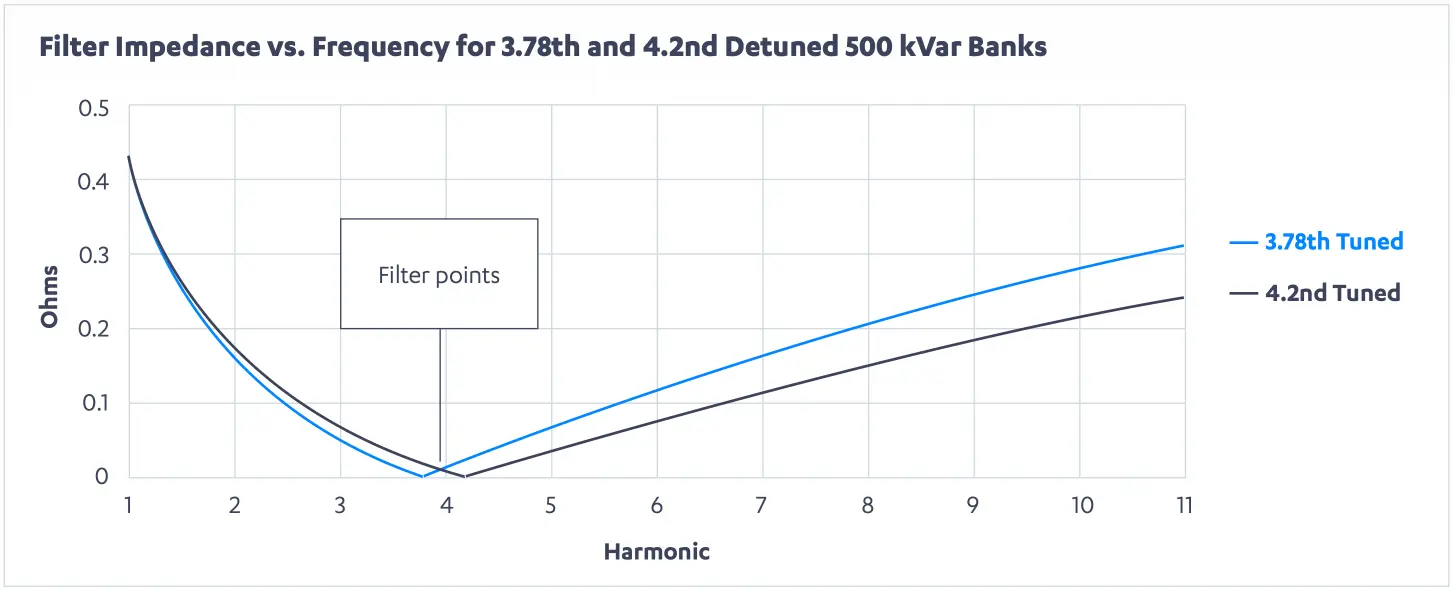
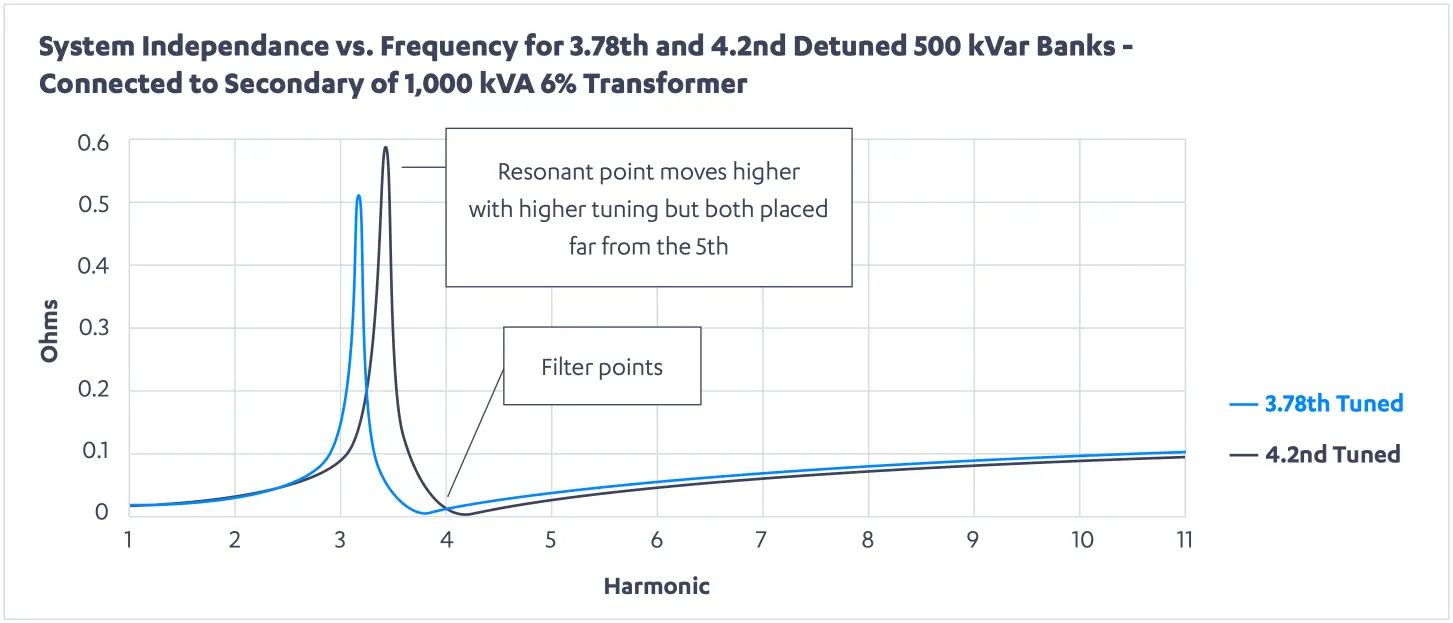
The 3.78th tuning option keeps us far from the fifth harmonic. This way, the bank does not absorb any significant amounts of harmonic current and behaves as harmonically neutral as possible. While not invoking a need for harmonic sizing, the bank pushes the resonant point closer to the third harmonic.
Standard Option #2: Tune at 4.2nd
In this option, the 4.2nd tuning is closer to the fifth harmonic, where it can absorb some of its current. This tuning also moves the resonant point further away from the third. Even so, the aborption is limited so that the bank behaves as harmonically neutral as possible while not invoking a need for harmonic sizing.
Table 1. Detuned Capacitor Bank Options & Application Notes
3.78th
4.2nd
Reactor %
7%
5.65%
Reactor Impedance
Higher – Larger voltage drop
Lower – Less voltage drop
Resonance Proximity
Far below 5th but closer to 3rd
Balanced between 3rd and 5th
Typical Applications
Strong harmonic environment
Moderate harmonic environment
Harmonic Blocking
4th and Above
5th and Above
(Powerside offers both in a single multitap detuned bank for added flexibility)
Fig. 1: Looking at filter impedance vs. frequency, this graph shows the driving point impedance scan for a 500 kVar bank with Standard Options #1 and #2.
Fig. 2: Looking at system impedance vs. frequency, this graph shows the driving point impedance scan for a 500 kVar with Standard Options #1 and #2 when connected to a 1,000 kVA transformer with 6% impedance.
There’s a Correction Solution for Your Power Quality Problem
Whether you’re experiencing amplified AFD harmonics, low power factor, voltage instability or any other number of complex power issues, Powerside is here to help.
Our comprehensive portfolio of power quality correction solutions help you overcome the effects of these issues to improve the reliability, resilience and lifespans of your equipment. Let our experts help you find the right solution for your needs today.
 Skip to the content