Preventing Imminent Cable-Termination Failure with Early THD Detection
Confirm that harmonic distortion levels returned to acceptable ranges
Expedite removal of suspect equipment quickly and confidently
Early detection prevented an impending cable termination failure, avoiding extended downtime, reduced reliability and the potential for a catastrophic system event
One of Powerside’s utility customers implemented routine maintenance on their substation equipment, but the finding was anything but typical. Shortly afterward, the utility began experiencing elevated levels of total harmonic distortion (THD), reducing the equipment’s efficiency and presenting the potential for further damage.
Operators also noticed a faint electrical “humming” sound using a hot line sniffer — a diagnostic tool that makes otherwise inaudible electrical discharges perceptible. While the signal clearly indicated a power quality issue, there was no visible point of failure or obvious source of the discharge.
The Challenge
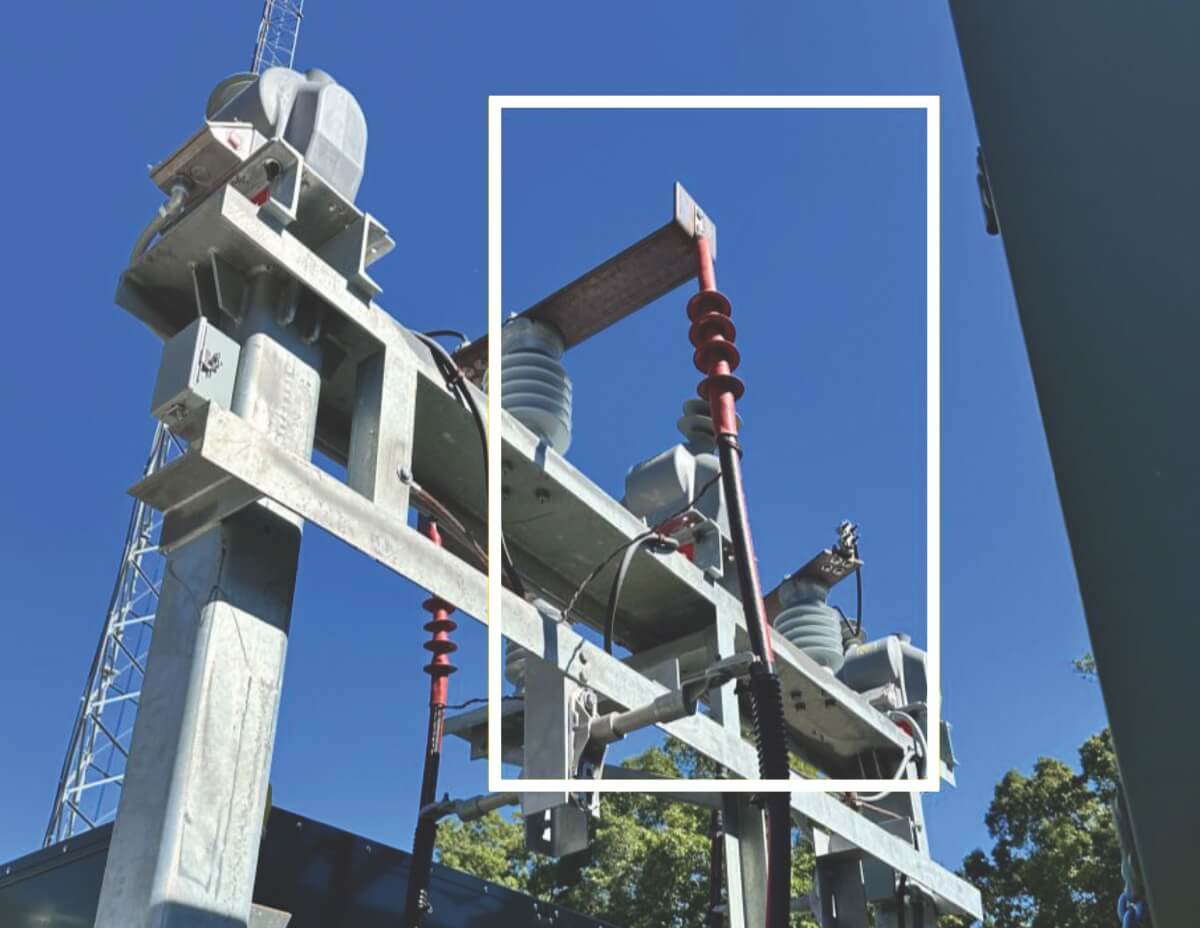
To investigate safely, the utility de-energized the suspect equipment to rule out other energy sources (Fig. 1). But upon re-energizing, the abnormal THD levels returned — along with the same hot line sniffer–detected electrical discharge — signaling that the root cause was still active and unresolved.
Figure 1 | Equipment with elevated levels of total harmonic distortion
Without resolving the harmonics quickly, the utility faced risks of:
Cable termination failure
Outage
Decreased reliability
The Solution
Fortunately, the utility’s power system already had QubeScan Monitoring Software installed via a PQube® 3 power analyzer in their STATCOM. This meant they had immediate, comprehensive access into their power quality analytics — and the elevated THD was visible before any obvious failure occurred.
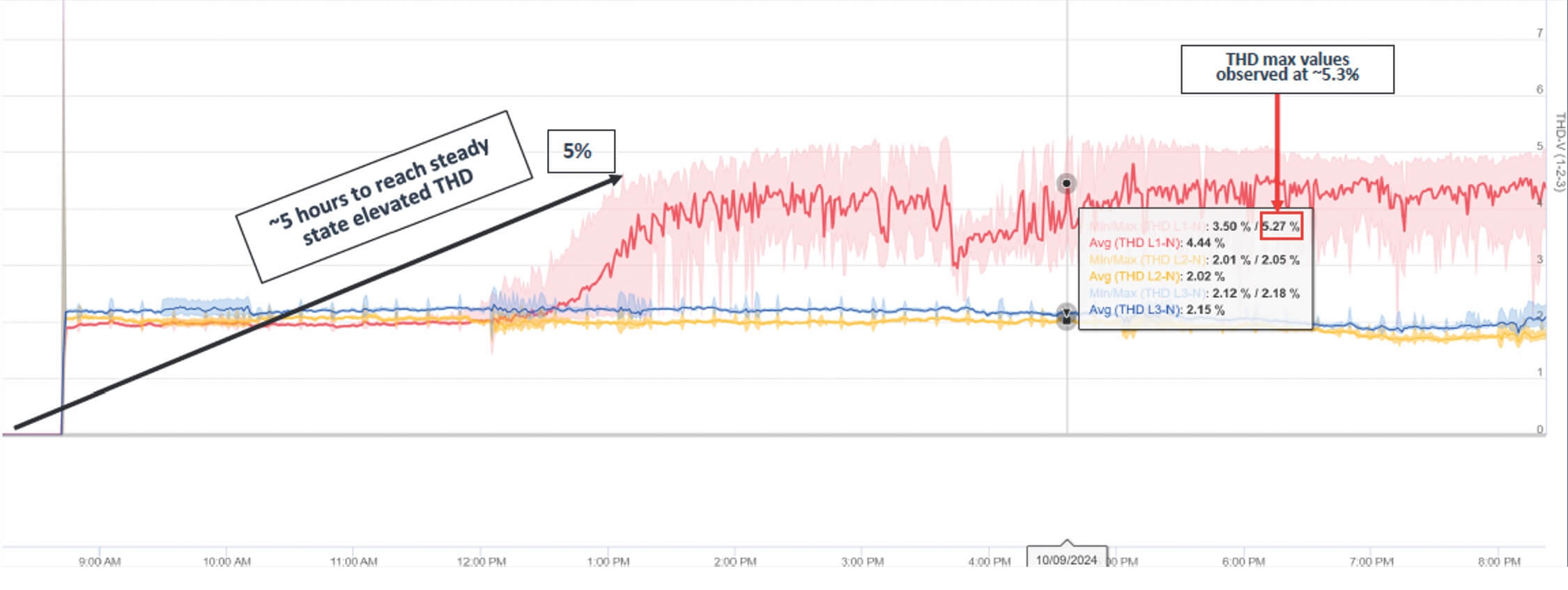
According to IEEE 519-2022, the standard for maximum THD at medium voltage is 5%. In this case, QubeScan recorded the harmonic distortion levels exceeding that at 5.3%, placing the system out of compliance. The maxed-out values were reached after energization, taking five hours for the THD to reach a steady state (Fig. 2).
Figure 2 | THD observations via QubeScan Monitoring Software
Because the issue was identified early — before catastrophic failure — a radio-frequency interference (RFI) sniffer tool was used to pinpoint the source of the electrical discharge. This tool quickly uncovered the issue: a badly crimped cable termination.
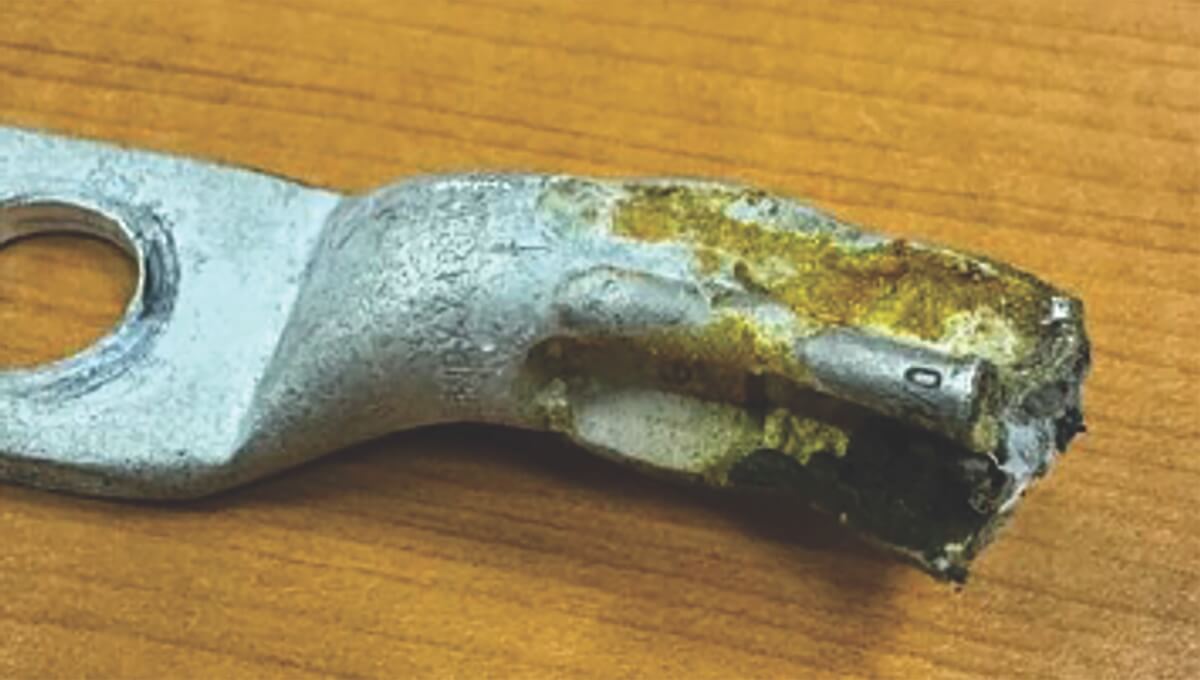
A teardown of the termination confirmed the diagnosis. The crimp was not uniform, showing discoloration and carbon buildup (Fig. 3).
Figure 3 | A poorly implemented, nonuniform crimp on the cable termination caused discoloration and was the culprit of electrical discharges that would’ve led to cable failure
This finding reinforced a critical best practice in both overhead and underground installations that Powerside Engineering Services always double-check: Crimp tools must be properly calibrated, and correct crimping techniques must be consistently applied.
Even small deviations can introduce power quality issues.
The Benefit
With QubeScan providing continuous remote visibility into their power quality conditions, the utility was able to:
Take corrective action to ensure the issue was fully mitigated
Confirm that harmonic distortion levels returned to acceptable ranges
Expedite removal of suspect equipment quickly and confidently
Most importantly, early detection prevented an impending cable termination failure, avoiding extended downtime, reduced reliability and the potential for a catastrophic system event.
Learn more about how proactive power quality monitoring can help your team identify and resolve issues before they have the chance to escalate.